
In David McGill’s book Sound in Motion: A Performer’s Guide to Greater Musical Expression, he recommends practicing all scales to both the top and the bottom of the instrument’s range. Experimenting with this advice a year ago, I wrote out major scale variations so that they all start in the mid-range, go up to high C (C6) or C♯, and then end on low C (C3) or C♯.
That has turned out to be a little too difficult, and it hasn’t been helping me work on modifying my aperture to be less spread in all ranges. So, last week I made another version. This one starts in the mid-range, goes up to high C, and returns to the mid-range starting note. It looks like this:
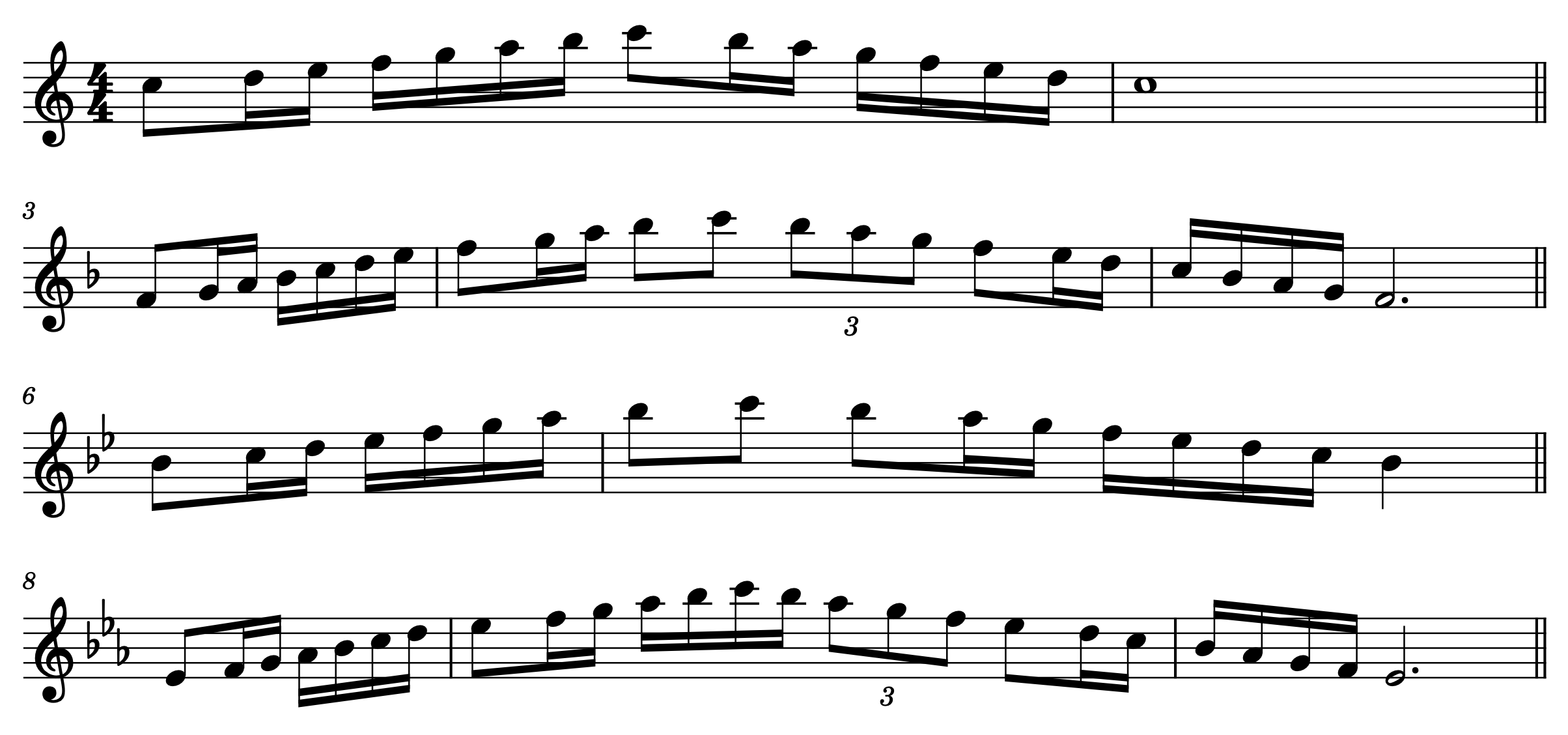
Sample from “To the High Cs”
For now, I am doing these slowly, quarter note = 50 or so. I’m doing them all slurred because I’m concentrating on continuous air flow; I can add the tongue later. I’m paying most attention to these factors:
- Open, clear high notes, with a kind of head-voice resonance in the back of my throat. If it starts sounding pinched, I rest for a moment and try it again.
- Accuracy on the way down.
- Not rushing on the way down.
The entire exercise is here; feel free to download it and try it out.
You do not need to create an account to leave a comment. Instead, just sign in using your email address or a GitHub account. Please be polite and respectful to all. Comments may be deleted or blocked by the site moderator for any reason. Email addresses are not published or saved. Personal information is not tracked.